A contract sewing shop can price your custom case from six inputs: the dimensions of the object going inside it, the quantity and release schedule, the material or the condition the case has to survive, the compliance clauses written into your contract, the packaging and marking requirements, and your need-by date. Everything else is refinement. Send those six and you get a real number instead of a range.
This RFQ checklist for custom cases walks through each input, what a complete answer looks like, and what happens to the quote when one is missing. It is written for the sourcing engineer or program manager assembling the package, not for a brand shopping for a garment factory. If you are building a case around a radio, an antenna assembly, a diagnostic instrument, or a tool kit, the useful information is different from what an apparel tech pack contains.
The six inputs a shop quotes from
Each row below is something the shop has to decide before it can price labor and material. When you leave one blank, the estimator either guesses high to cover the unknown or emails you to ask. Both cost you time.
| Input | What a complete answer looks like | What it decides |
|---|---|---|
| The object going inside | Dimensions at the widest points in three axes, loaded weight, every protrusion | Pattern development, panel count, internal layout |
| Quantity and schedule | Prototype count, first production run, estimated annual usage, number of releases | Cutting method, material buy, unit price |
| Material or performance | A named spec, or the conditions the case has to survive | Substrate, hardware, cost, lead time |
| Compliance clauses | The DFARS clause in your contract, whether the drawings are export controlled | Sourcing, documentation, how you send files |
| Packaging and marking | MIL-STD numbers if they apply, or commercial packaging | Labor, labeling, shipping |
| Dates | Need-by date, and whether it is hard or a target | Scheduling and whether a rush surcharge applies |
Request a Quote from Christian Workshop
Measure the object, not the case
Give the shop the equipment’s dimensions, not the dimensions of the bag you pictured around it. A soft case gets built from the object outward, so the pattern maker works from the loaded footprint and adds material thickness, seam allowance, padding, and clearance. A case sized from a guessed exterior almost always comes back either tight at the corners or loose enough to let the contents move.
What to record for the object
| Field | Notes |
|---|---|
| Length, width, height | At the widest point on each axis, including feet, bumpers, and mounting brackets |
| Loaded weight | Drives handle and strap construction, hardware rating, and stitch pattern at stress points |
| Protrusions | Antennas, connectors, latches, knobs, and anything that has to clear a wall or a zipper track |
| Cable and port access | Whether cables exit while the case is closed, and from which face |
| Access face | Which side opens most often, and whether the object comes out or stays in |
| Fragile points | Screens, lenses, sensors, hinges, and anything that needs padding thicker than the rest |
| Accessories | Batteries, cables, chargers, tools, or documents riding along, with their own dimensions |
| Handling | Carried by hand, worn, strapped to a vehicle, stacked, or slung under a shoulder |
What goes in the case and what needs protecting
Two separate questions, and buyers regularly answer only the first. Listing the contents tells the shop how much volume to build. Saying which of those contents can take a knock and which cannot is what determines whether the interior is a single padded cavity, a foam cradle cut to the object, or dividers with pocket layouts.
Say what the case has to survive in service. A drop height, a stacking load, or a description of the environment gives the shop something to design against. If you have a test standard in the contract, name it. If you do not, plain language works: dropped off a tailgate, thrown in the back of a truck, carried through a hangar every day for five years.
Quantity, releases, and why one number is not enough
Quote quantity as a schedule rather than a single figure. Give the prototype count, the first production run, your estimated annual usage, and whether the total ships at once or in staged releases. Pattern work, marker layout, and cutting setup get amortized across the run, so the same case at 10 units and at 500 units carries two different unit prices.
The release schedule matters as much as the total. A shop quoting 1,000 units across four releases over eighteen months can buy material once, cut once, and warehouse the balance. That is a different cost structure from four separate orders of 250 placed as needed, and it usually favors you.
Quantity also decides the cutting method. Low counts get cut by hand or laser off a digital file. Higher counts justify a steel rule die, which costs money once and then pays for itself in speed and repeatability. Telling the shop your real annual volume lets it recommend the method that costs you less overall, rather than the one that looks cheapest on a first order.
If the quantity genuinely is unknown, say so and give a bracket. A quote at 50, 250, and 1,000 units is easy to produce in one pass and gives you the shape of the curve. Writing “TBD” gets you nothing.
Materials, or the conditions the case has to survive
You do not have to name a fabric. Describing what the case has to withstand is often more useful than a material callout, because the shop has already solved the same problem for other programs and can propose a substrate that meets the requirement at a lower cost than the one you would have specified.
Conditions worth stating: abrasion against concrete or vehicle decks, sustained UV, water exposure and whether it needs to shed or seal, operating temperature range, fuels and solvents, flame resistance, and whether the case rides outdoors permanently or lives in a cabinet.
If you do have a spec, give the whole callout rather than the family name. “Cordura” describes a brand of nylon in a dozen weights. A denier, a weave, a coating, and a mil-spec number tell the shop exactly what to buy. The same applies to hardware: a buckle rating, a zipper size and chain type, and whether hardware has to be non-metallic or non-reflective.
Christian Workshop works in ballistic nylon, Cordura, packcloth, ripstop, cotton duck, clear vinyl, Naugahyde, polyurethane and polyethylene foam, XLPE, ABS, HDPE, Kydex, and leather from garment weight through heavy tooling. The full list sits on the materials page, and the equipment page covers what can be cut, stitched, and embossed in house.
Compliance clauses and controlled drawings
Name the clauses at quote stage, not at award. If your contract carries a Berry Amendment clause such as DFARS 252.225-7012, the shop has to price domestic material and build in the documentation work from the start. Finding out after the quote is accepted means requoting, because compliant material and commercial material are different line items with different lead times.
What to state in the RFQ
- The specific DFARS or FAR clauses flowed down to you, quoted by number
- Whether origin documentation and mill certificates have to accompany delivery
- Whether the drawings you are sending are ITAR-controlled technical data
- Whether the package includes controlled unclassified information and what handling it requires
- Any quality system requirement, and whether an inspection system clause applies
- Whether a nondisclosure agreement has to be executed before you send anything
Ask how the vendor receives controlled data before you send it. A dimensioned drawing of a defense article is controlled technical data in its own right, and emailing it to a general sales address is the wrong first move regardless of who the vendor is. Confirm the method, confirm who has access on the other end, and put the answer in your file. That is a one-line question that prevents an export control problem.
Registration and credential detail for Christian Workshop, including the CAGE code and NAICS codes, is on the credentials page.
Packaging, marking, and inspection requirements
Packaging and marking are line items, and buyers leave them out of RFQs more often than any other requirement. Military marking, individual item identification, and preservation packaging each add labor and materials to every unit. A quote that assumed a poly bag and a commercial carton will not survive contact with a contract that calls for barcoded military shipping labels.
State which of these apply to your order:
- MIL-STD-129 military marking for shipment and storage, which governs the labels on containers and palletized shipments
- MIL-STD-130 item identification marking, which applies to the individual unit rather than the container
- MIL-STD-2073-1 military packaging, where preservation level is specified
- First article inspection, including the report format and where it gets submitted
- An inspection system clause such as FAR 52.246-2 or FAR 52.246-3
- Serialization, lot traceability, or unit-level barcoding
- Woven labels, printed labels, embroidery, contract numbers, or national stock numbers applied to the product
- Ship-to destinations, and whether units go to one address or several
If none of this applies and commercial packaging is acceptable, say that too. It is a faster answer than silence, and it keeps the estimator from pricing in a requirement you never had.
What to send when you have no drawings
Send the object. A physical sample of the equipment, or the case currently in service that you want replaced, gives a pattern maker more usable information than a drawing does, and it removes the interpretation step entirely. Shops that build from samples routinely quote faster off a box than off a file.
When shipping the object is not possible, the next best package is photographs from six sides with a ruler or a tape in frame for scale, a hand sketch with measurements written on it, and a written description of how the case gets used. None of that has to be pretty. It has to be dimensioned.
Formats worth asking about before you export anything: PDF drawings are universally readable, DXF and DWG carry flat pattern geometry, and STEP files describe the solid object the case wraps. Confirm what the shop can open rather than assuming, and confirm the transmission method separately if the file is controlled.
The checklist
Copy this into your RFQ and fill in what you know. Mark the rest as open rather than deleting it, so the shop can price around the gap instead of guessing at it.
Program and contact
- Company, program name, and the technical point of contact
- Whether this is a new build, a replacement for an existing case, or a repeat order
- If a repeat order, the previous part number or purchase order
- Whether an NDA is required before technical exchange
The object and the case
- Object dimensions at the widest points, all three axes
- Loaded weight
- Protrusions, connectors, and cable exits
- Accessories carried in the same case, with dimensions
- Fragile points that need extra padding
- How the case is carried, mounted, or stored
- Closure preference, and whether the closure has to be operated with gloves
- Interior approach: open cavity, foam cradle, dividers, or pockets
- Drop, stacking, or environmental requirements, stated as a standard or in plain language
Volume and timing
- Prototype quantity
- First production quantity
- Estimated annual usage and expected program life
- Release schedule, or a request for pricing at several quantity breaks
- Need-by date, and whether it is firm
Materials and compliance
- Specified materials with full callouts, or the conditions the case must survive
- Hardware requirements, including any non-metallic or non-reflective restriction
- Color and any embroidery, printing, or labeling
- DFARS and FAR clauses flowed down to your order
- Whether documentation has to ship with the goods
- Export control status of the drawings, and the required transmission method
Delivery
- Packaging and marking standards that apply
- First article inspection and reporting requirements
- Ship-to addresses and whether the order splits
- Files attached: drawings, photographs, sketches, specifications, and prior samples
Call Christian Workshop: (321) 676-2396
What slows a quote down
Most quote delays are not the shop’s queue. They are one missing field that triggers an email, then a reply two days later, then a second question the first answer raised. A complete package quotes in one pass; an incomplete one quotes in three.
The omission that costs the most is weight. Without it the estimator cannot size handles, straps, or hardware, and cannot judge stitch construction at the stress points, so the whole carry system stays unpriced.
Photographs with no scale reference run a close second. A picture of a black instrument on a bench could be a handheld radio or a rack unit. Put a tape measure in the frame and the photograph becomes usable.
“Same as the last one” without a part number sends someone digging through old files, and the older the program, the longer that takes. A quantity written as TBD gets priced at the smallest plausible run, which is the most expensive per unit. And a compliance clause disclosed after the quote lands means the quote gets rebuilt from the material up.
Sending it to Christian Workshop
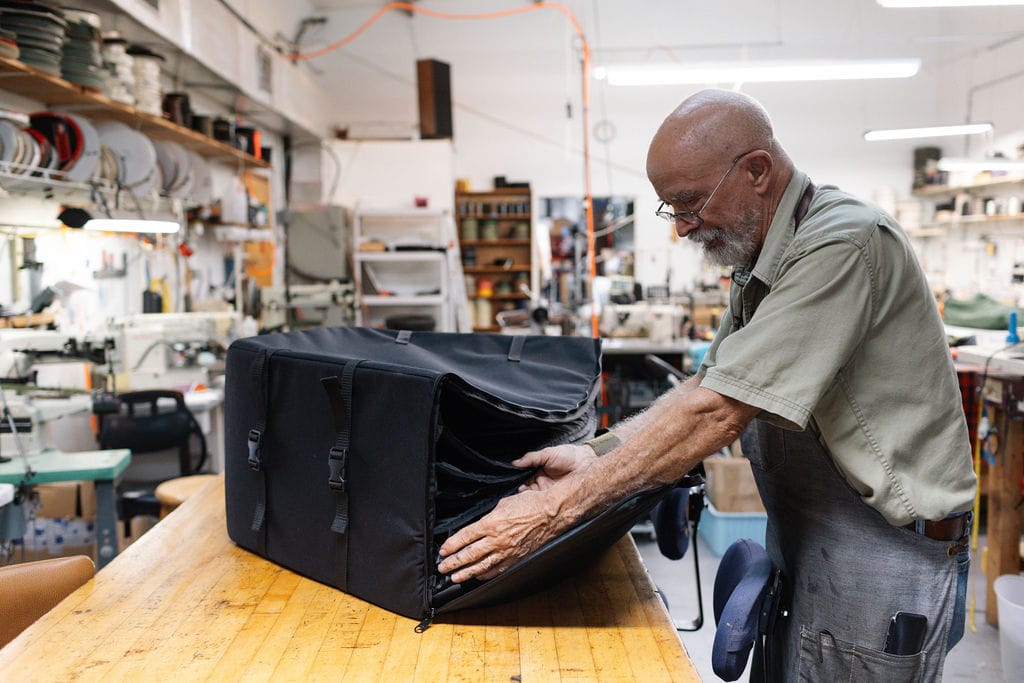
Christian Workshop is a contract industrial sewing and fabrication company at 405 West Dr., Melbourne, Florida, in business since 1971. Design, prototyping, and production all happen in the same 6,000 square foot building, on more than 20 industrial sewing machines with commercial laser cutting, die cutting, and embroidery alongside them.
Minimums are low, and orders can ship as a single run or as staged releases across the life of a program. That combination suits prototype work and pilot builds, where the quantity is small at the start and the schedule is not settled yet.
| Detail | Value |
|---|---|
| Address | 405 West Dr., Melbourne, FL 32904 |
| Phone | (321) 676-2396 |
| CAGE code | 0FDR6 |
| DUNS | 040211344 |
| NAICS | 314910, 316990 |
| Registrations | SAM registered, ITAR registered, D&B registered, ATA member |
| Production | Single facility, Melbourne, Florida. Cut, sewn, and finished in house. |
| Volume | Low minimums, single or staged releases |
The product categories page shows the range of soft cases, pouches, covers, duffel and transit bags, straps, and foam inserts already built here, which is often the fastest way to tell whether your part is a familiar shape or a genuinely new one.
Frequently asked questions
What information does a case manufacturer need to quote?
Six things: the dimensions and weight of the object going inside, the quantity and release schedule, the material spec or the conditions the case has to survive, any compliance clauses in your contract, the packaging and marking requirements, and your need-by date. Anything beyond that improves the quote. Anything missing from it either delays the quote or inflates it.
Do I need a tech pack or CAD drawing to get a quote?
No. Tech packs come out of the apparel world and assume size runs and graded measurements, which do not apply to a case built around one piece of equipment. A dimensioned sketch, photographs with a scale reference, or the object itself all work. A CAD file speeds up pattern development but is not a precondition for pricing.
What is the minimum order for a custom case?
It varies by shop, and many contract sewing operations set minimums high enough to exclude prototype work. Christian Workshop runs low minimums, which is why prototype and pilot quantities are worth asking about rather than assuming. Give your annual volume alongside the first order so pricing reflects the program, not the sample.
Can I send a physical sample instead of drawings?
Yes, and it is often the better option. A pattern maker working from the actual equipment, or from the case being replaced, skips the interpretation step that drawings require. Send a note describing how the case is used in service along with the sample, and state whether you need the item returned.
How do I send ITAR-controlled drawings to a sewing vendor?
Ask the vendor first, before attaching anything. A dimensioned drawing of a defense article is controlled technical data in its own right, so the transmission method and access control on the receiving end both matter. Confirm how the vendor accepts controlled files, who can view them, and whether an NDA or a signed acknowledgment comes first.
Does a case quote include military packaging and marking?
Only if you ask for it. MIL-STD-129 shipment marking, MIL-STD-130 item identification, and MIL-STD-2073-1 preservation packaging each add labor and materials per unit, and a quote written against commercial packaging will not cover them. List the applicable standards in the RFQ, or state plainly that commercial packaging is acceptable.
How long does a custom case quote take?
It depends on the complexity of the part and on whether material pricing has to come back from suppliers before the estimate can close. The variable you control is the package. A complete RFQ gets priced in a single pass, while a partial one turns into a series of clarifying emails that adds days for reasons that have nothing to do with the shop’s workload.
Send Your RFQ to Christian Workshop
Not ready for a formal RFQ? Start on the contact page and describe the part in plain language.